
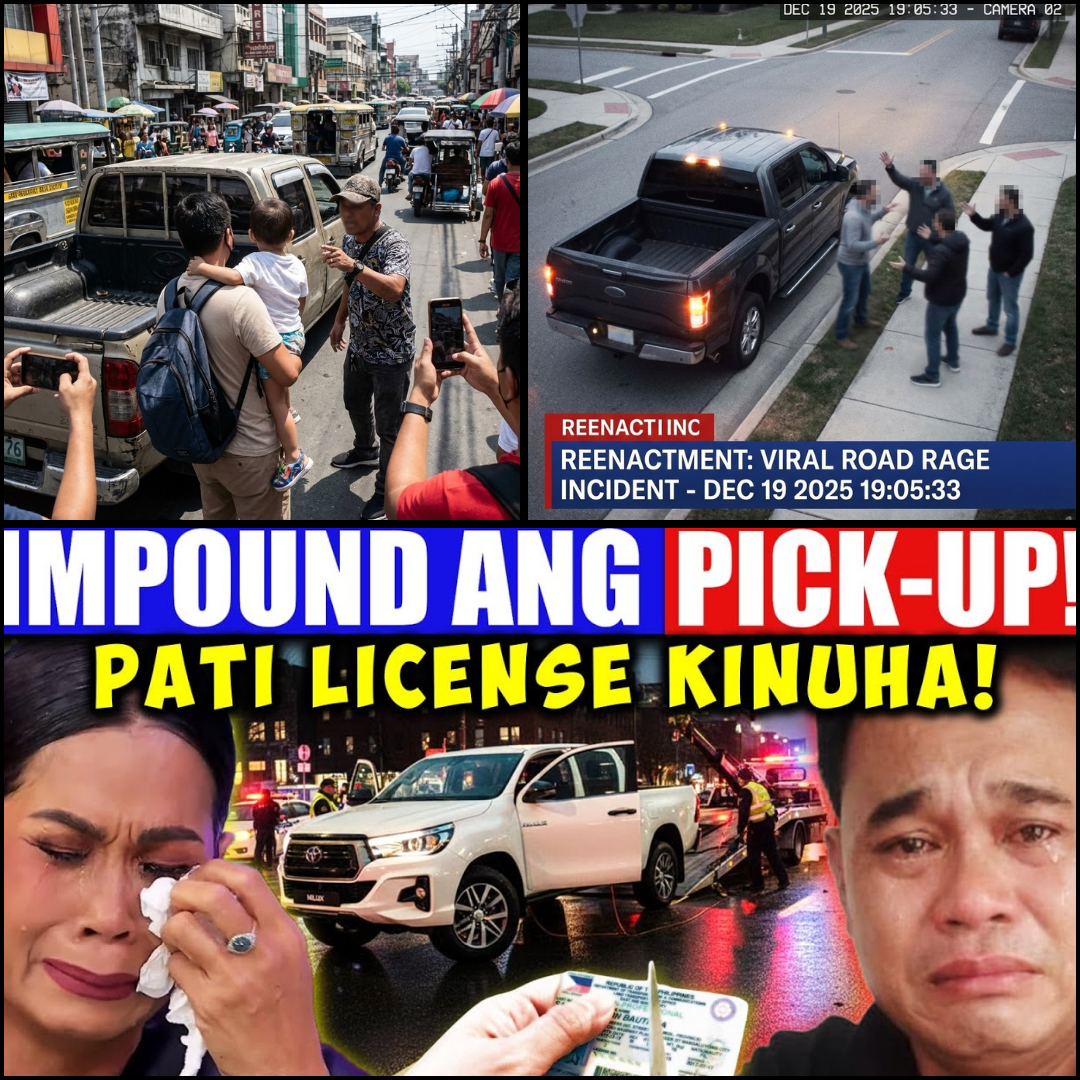
I. THE ANATOMY OF AN ALTERCATION
The streets of Metro Manila and its surrounding provinces are notorious for their congestion and the short fuses of their motorists. However, what occurred on a seemingly ordinary afternoon was not just a case of “Road Rage” but a profound demonstration of the clash between social privilege and public accountability.
The incident began on a narrow road where a father and his young son were manually pushing a heavy karito (wooden cart). In the Philippines, these carts are often used by informal laborers to transport scrap metal, goods, or water. They are heavy, difficult to maneuver, and lack the braking systems of motorized vehicles.
As the father-son duo navigated the edge of the road, a high-end pickup truck, driven by a man later identified as the brother of a prominent public figure (known in social circles as “Pwang”), attempted to overtake them. According to initial reports, the driver believed—incorrectly, as it turned out—that the wooden cart had struck the side of his expensive vehicle.
What should have been a brief stop to check for scratches turned into a volcanic explosion of rage. The driver exited his vehicle and immediately began a verbal assault. He did not ask for insurance; he did not look at the damage. He screamed profanities that echoed through the street, terrifying the young boy standing beside his father. Witnesses reported that the driver’s aggression was not just verbal but contained physical posturing intended to intimidate those he deemed “lower” on the social ladder.
II. THE VIRAL CATALYST: POWER IN THE HANDS OF BYSTANDERS
In decades past, this incident might have ended with the father and son apologizing for a crime they didn’t commit, cowed by the driver’s expensive clothes, vehicle, and aggressive demeanor. But we live in the era of the “Smartphone Witness.”
A bystander, sensing the injustice of the situation, began recording the encounter. The footage captured the driver’s most damning moment: he threatened to have the father’s “license” revoked. The absurdity of the threat—made to a man who was walking on foot pushing a cart—highlighted the driver’s disconnect from reality and his reliance on “power-tripping” tactics.
The video was uploaded to social media and went viral within hours. Netizens were not just angry at the traffic dispute; they were disgusted by the “bully” tactics used against a vulnerable child and his father. The public outcry reached a fever pitch, demanding that the Land Transportation Office (LTO) take action against the man who appeared to believe he owned the asphalt.
III. THE LTO’S INVESTIGATION: PRIVILEGE VS. THE LAW
The Land Transportation Office, led by its Intelligence and Law Enforcement divisions, moved with uncharacteristic speed. They summoned the driver to a series of hearings.
One of the most significant hurdles in such cases is the “settlement” or areglo. Reports surfaced that the driver had reached out to the father and son, offering an apology and potentially a financial settlement to avoid a formal complaint. In many Philippine legal scenarios, if the complainant “desists” (withdraws), the case dies.
However, the LTO released a landmark resolution. They clarified that while the criminal or civil aspect might be settled between private individuals, the administrative privilege of holding a driver’s license is a matter of the State.
The LTO’s position was clear:
A License is a Privilege: It is not a constitutional right. It is a grant given by the government to individuals who prove they are fit, both technically and morally, to operate a ton of steel on public roads.
The “Improper Person” Clause: Under existing laws, the LTO has the authority to revoke the license of any individual deemed an “improper person to operate a motor vehicle.” This includes those who exhibit reckless behavior, lack of emotional control, and a history of road rage.
IV. THE PERMANENT REVOCATION: A LEGAL “DE@TH PENALTY”
After reviewing the video evidence and conducting the hearings, the LTO Intelligence Division issued its recommendation: Permanent Revocation of the Driver’s License.
This is the harshest penalty the LTO can levy. It means the individual is not just suspended for a few months; he is effectively banned from legally driving a motor vehicle in the Philippines for life. The resolution noted that the driver’s inability to control his temper, his use of threats in front of a minor, and his blatant attempt to use his social standing to intimidate others proved that he was a “danger to the motoring public.”
But the LTO didn’t stop there. They also “alarmed” the vehicle involved in the incident. In LTO parlance, an “alarm” is a digital red flag. It prevents the vehicle from being:
Sold or Transferred: Any attempt to sell the pickup truck to a third party will be blocked by the system.
Re-registered: The owner cannot renew the registration, making it illegal to drive on any public road once the current registration expires.
Used as Collateral: It cannot be pawned or used in financial transactions.
This “freezing” of the asset was a strategic move to show that the consequences of road rage extend beyond the person to the very machine used in the commission of the intimidation.
V. THE PSYCHOLOGY OF ENTITLEMENT AND THE “BODYGUARD” ISSUE
During the investigation, a darker detail emerged from the father’s affidavit: the presence of “security” or “bodyguards.” The father claimed that the driver’s associates added to the atmosphere of fear, making him feel that his life was in danger if he didn’t submit to the driver’s whims.
The LTO addressed this directly, stating that the use of private security to influence or intimidate during traffic disputes is a gross violation of the spirit of the law. They emphasized that wealth and the ability to hire “muscle” do not grant a motorist extra space on the road or a “pass” to mistreat others.
Psychologically, this case is a study in “status-driven aggression.” The driver viewed the father and son not as fellow citizens but as obstacles. When he felt his “status symbol” (the truck) was threatened, his response was to re-assert his dominance through verbal violence. The LTO’s resolution effectively stripped him of the very thing that facilitated his sense of superiority on the road: his ability to drive.
VI. THE PRECEDENT: PUBLIC SAFETY OVER PERSONAL RELATIONS
The most vital takeaway from this case is the LTO’s refusal to let the case be “settled” privately. For years, the Philippines has struggled with a “culture of impunity,” where those with connections to “Pwang” or other influential figures could simply make a phone call and have their tickets or violations erased.
By standing firm despite the lack of a formal complaint from the victim, the LTO sent a message to all motorists: The State is the complainant. When you threaten a citizen on the road, you are threatening the order and safety of the Republic.
The driver has the right to appeal, but the LTO has made it clear that the bar for reinstatement will be nearly impossible to clear. They have mandated that even if an appeal is filed, the “alarm” on the vehicle and the revocation of the license remain in effect throughout the process.
VII. CONCLUSION: THE ROAD TO ACCOUNTABILITY
The story of the brother of “Pwang” is more than a gossip headline. it is a turning point in traffic law enforcement. It proves that:
Viral Videos are Evidence: The LTO now officially recognizes social media footage as a primary tool for “probable cause” investigations.
Character Counts: You can be a perfect driver in terms of parking and signaling, but if you are an “improper person” morally, you lose your license.
The Poor have a Voice: The father and son, who had no money or influence, were protected by the collective voice of the internet and a government agency that, for once, chose the side of the marginalized.
As we move forward, every driver in the Philippines must remember that every time they turn the ignition, they are agreeing to a contract of civility. The road is a shared space, not a private kingdom. If you cannot respect the person in the smallest cart, you do not deserve to drive the biggest truck.
News

Ang Mafia Boss at ang Katulong: Isang Gabi ng Pagtataksil, Pagpapasuso, at Sikretong Nagpabago sa Isang Madilim na Imperyo! Tunghayan kung paano nailigtas ng isang ina ang sanggol na hindi sa kanya sa gitna ng panganib at lupit ng Chicago Underworld.
Kabanata 1: Ang Alingawngaw sa Dilim Sa loob ng naglalakihang pader ng mansyon ni Matteo Reichi, ang pinakamabagsik na mafia…

SA LOOB NG 72 ORAS, TATLONG BALI NA RIBS, AT ISANG LUNG NA PUNO NG DUGO, NAGPANGGAP SI MIA NA OKAY LANG ANG LAHAT—HANGGANG SA BUMAGSAK SIYA SA BISIG NG PINAKAMAPANGANIB NA DEMONYO NG NEW YORK NA SI MATTEO VALENTE!
KABANATA 1: ANG PAGGUHO NG ISANG ANINO Tatlong araw. Pitumpu’t dalawang oras. Apat na libo, tatlong daan at dalawampung minuto…

Isang dukhang tagalinis, isang malupit na mafia boss, at isang maysakit na sanggol: Paano babaguhin ng isang pagkakamali ang tadhana nila sa gitna ng malamig na gabi sa New York? Tuklasin ang kuwentong magpapaiyak at magbibigay-pag-asa sa inyo sa gitna ng kadiliman at mga lihim.
Kabanata 1: Ang Bulong sa Gitna ng Unos Sa gitna ng malupit na taglamig sa New York, ang bawat hininga…

Pulis, Nagulat nang Makita ang Sariling Anak na 6-anyos na Pinahihirapan sa Gitna ng Nyebe! Ang Nakatagong Katotohanan sa Likod ng pasan-pasan niyang Kahoy ay Dudurog sa Inyong Puso at Magpapakulo ng Inyong Dugo. Isang Rebelasyong Hindi Ninyo Malilimutan!
Kabanata 1: Ang Pasabog ng Katotohanan sa Gitna ng Nyebe Sa isang abuhing hapon ng taglamig, tila bumibigat ang bawat…

HINDI SIYA DAPAT NARITO: Ang Misteryosong “Maintenance Man” na Nakatuklas sa Madilim na Lihim ng 10th Floor — Isang Makapigil-hiningang Kuwento ng Hustisya, Kapangyarihan, at ang Katotohanang Pilit Itinatago sa Likod ng mga Saradong Pintuan ng Isang Higanteng Gusali sa Pilipinas!
KABANATA 1: ANG ANINO SA DILIM NG EMPIRE Hindi siya dapat nadoon sa palapag na iyon. Ang pinto ng supply…

Isang Tawag sa Madaling-Araw: Sikretong Pag-ibig, Mafia, at ang Gabi na Nagpabago sa Lahat!
Kabanata 1: Ang Tawag sa Kalagitnaan ng Gabi Ang nakakairitang tunog ng aking cellphone ang humila sa akin mula sa…
End of content
No more pages to load