
THE ANATOMY OF A BUREAUCRATIC FALL
I. Prologue: The Woman Who Knew Too Much
In the annals of Philippine governance, few individuals possessed the sheer technical dominance of Maria Catalina “Kathy” Cabral. Born in May 1962, she didn’t just work for the Department of Public Works and Highways (DPWH); she helped build its modern digital infrastructure over four decades of service.
Rising from an engineering aid to the Undersecretary for Planning and Public-Private Partnerships, Cabral was the definitive “Brain” of the agency. With master’s degrees from Wharton and Harvard and a PhD candidacy at UP, she was an elite technocrat in a field often dominated by political appointees.
However, by late 2025, her accolades were eclipsed by a gathering storm. Cabral was identified as the central figure in the Flood Control Anomaly, a scandal involving the alleged siphoning of billions of pesos into non-existent or “ghost” projects.
On September 14, 2025, she resigned. Three months later, as the Senate Blue Ribbon Committee was preparing subpoenas that would have forced her to name names, her b0dy was found broken at the bottom of a 30-meter ravine in Tuba, Benguet.
II. The Final 24 Hours: A Timeline of Inconsistencies
The events of December 18, 2025, portray a woman seeking a solitude that defied her own psychological nature.
10:00 AM: Cabral and her driver, Ricardo Hernandez, were traveling through Kennon Road toward La Union. Cabral ordered a stop near the Camp Bridge. Witnesses—including a local policeman—noted her sitting on a concrete barrier near a 20-meter drop. The policeman ordered them to move, warning that the area was an accident-prone “no-parking” zone.
1:00 PM: The pair checked into the Ion Hotel in Baguio City. They dined together, and the driver reported that her “aura” seemed normal.
2:30 PM: Despite the morning’s police warning, Cabral insisted on returning to the exact same spot on Kennon Road. She ordered Ricardo to leave her there to “meditate” and return later after getting gasoline.
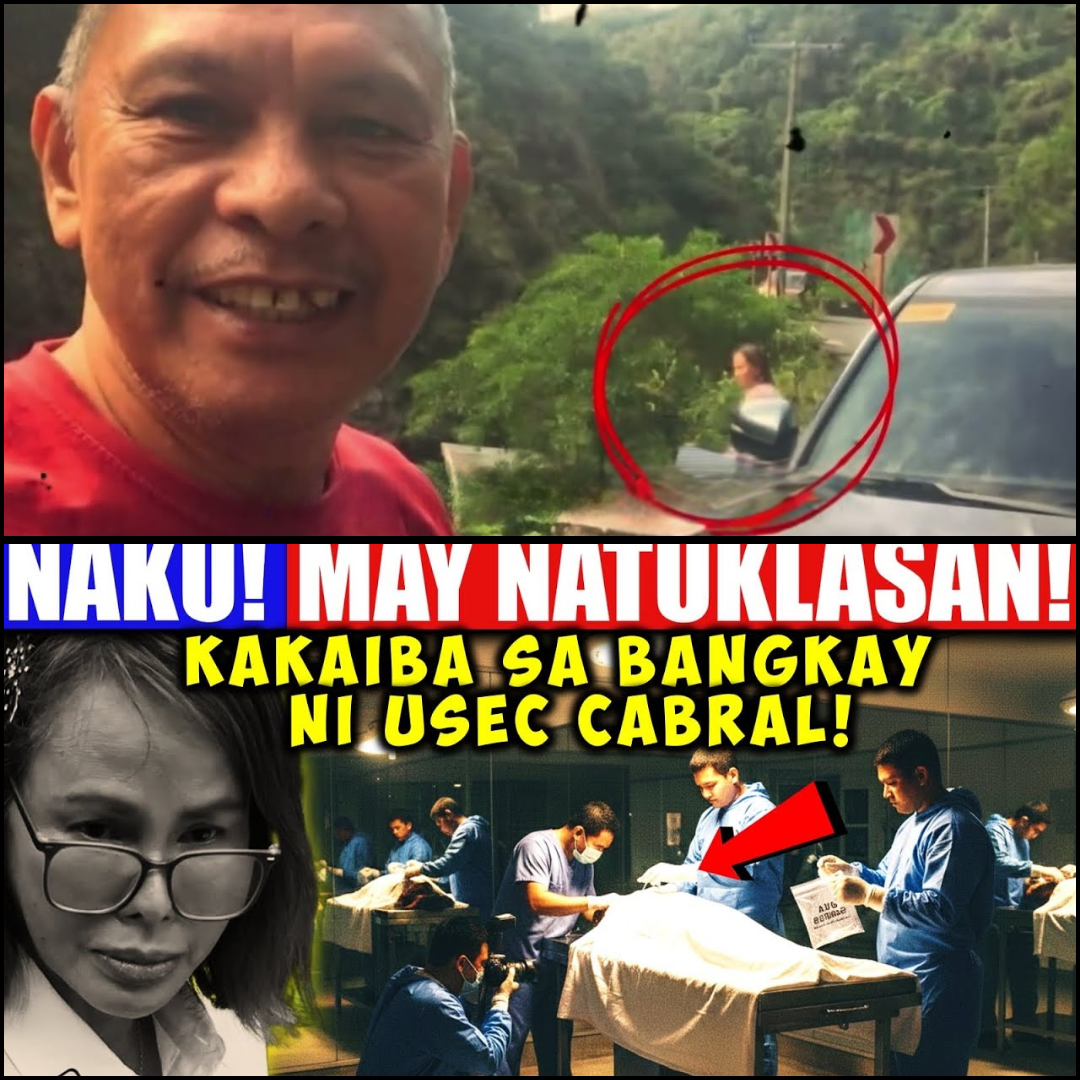
3:00 PM: The last time Ricardo saw her alive. He took a now-viral “selfie” with Cabral visible in the background, sitting on a jagged rock.
5:00 PM – 7:00 PM: Ricardo returned to pick her up but found the spot empty. He searched the perimeter, checked the hotel, and finally sought police assistance as night fell.
8:00 PM: Rescue teams using high-powered flashlights spotted a figure near the Bued River, 30 meters below the highway.
By dawn on December 19, Kathy Cabral was officially declared de@d.
III. The Acrophobia Paradox: Fear vs. Reality
The most significant psychological “red flag” in the suicide/accident theory is Cabral’s clinically documented acrophobia (fear of heights). In a 2018 interview with DLC Design and Construction Magazine, she was asked about her biggest phobia. Her answer was immediate: Heights.
A person with severe acrophobia doesn’t simply “get over it” to sit on the edge of a precipice for over an hour. Behavioral psychologists argue that such a condition triggers an autonomic nervous system response—vertigo, nausea, and an overwhelming “flight” instinct.
The investigation shows that Cabral didn’t just end up at a height; she sought it out twice in one day, even after being warned by authorities. For many, this behavioral shift suggests either extreme mental duress or that she was forced into a scenario designed to look like a voluntary act.
IV. The Nerve Center: Controlling the “BBM Parametric Formula”
To understand why Kathy Cabral was so dangerous to the powerful, one must understand the digital tools she controlled. Cabral oversaw the Information Management Service (IMS)—the neural network of the DPWH. She was in charge of:
RBIA (Roads and Bridges Information Application): The central database for every national infrastructure asset.
MYPS (Multi-Year Programming System): The tool used to schedule and prioritize projects over a 6-year period.
HDM4: Software used to manage highway density and project viability.
But her most controversial creation was the BBM Parametric Formula (Baseline Balanced Managed). Former DPWH Undersecretary Roberto Bernardo described this formula as a “black box” that only Cabral truly understood. Critics, including Batangas Representative Leandro Leviste, allege that this formula was used to “cook” the budget.
By manipulating the parameters in the system, Cabral could allegedly justify the insertion of billions of pesos into specific districts for “flood control,” which functioned as a refined, digital version of the old pork barrel system.
V. Forensic Anomalies and the “Mary Ann Maslog” Spectre
The physical evidence from the ravine in Tuba has only deepened public skepticism.
The Clothing Shift: Witnesses saw her in jeans and a jacket in the morning, but her b0dy was recovered in a pink blouse and dress. This implies she returned to the hotel to change—a level of preparation that contradicts the image of a woman acting on a spontaneous “stress-induced lapse.”
The “Clean” Scene: DILG Secretary Jonvic Remulla cited “blunt force trauma” and the lack of foreign DNA under her nails as proof of no foul play. However, legislators like Senator Kiko Pangilinan have pointed out that professional “silencing” or a “staged de@th” wouldn’t necessarily leave defensive wounds if the victim were incapacitated first.
The Precedent: Public trust has been eroded by the case of Mary Ann Maslog, the 1990s scammer who “died” for five years to escape prosecution. Many believe Cabral—with her immense resources and connections—could have staged her de@th to vanish before her trial. This theory is bolstered by the history of Tuba, Benguet, as a notorious “dumping ground” for b0dies.

VI. The Battle for the Digital Ledger
The aftermath of Cabral’s de@th triggered a jurisdictional war. Ombudsman Samuel Martires issued an unprecedented directive to secure all of Cabral’s electronic devices. Why? Because it is believed her smartphone and office computers contained the “Digital Ledger of Proponents”—the names of every politician and contractor who benefited from the parametric insertions.
The scandal intensified when the national government sacked the Benguet Provincial Director and the Tuba Chief of Police. The official reason was “failure to treat the scene as a crime scene.” However, insiders suggest the real reason was that the local police allowed the family to take Cabral’s phone, thereby losing government control over the potentially incriminatory data.
VII. The Discaya Connection and the Waymaker Syndicate
While the nation watched the ravine, the AMLC (Anti-Money Laundering Council) was mapping the flow of money. Over Php 180 Billion was found to have moved through accounts linked to the Discaya family, contractors who named their firms after saints (St. Gerard, St. Matthew).
These firms were the primary beneficiaries of the projects Cabral’s office planned. The investigation has revealed a “SOP” (Standard Operating Procedure) where contractors would meet with congressmen’s chiefs of staff to offer “advance percentages” on projects that were guaranteed by Cabral’s parametric formula. Shortly after Cabral’s de@th, reports surfaced that the computers in her private office—which Batangas Rep. Leviste called the “key to the agency’s corruption”—had been removed by unidentified personnel.
VIII. Conclusion: A Silent Ledger
The de@th of Kathy Cabral is the climax of a multi-billion peso drama. She was a woman of immense intellect who used her talents to build a system of impenetrable complexity. Whether she was a woman who finally broke under the weight of her secrets or a witness who was “removed” from the equation to protect a high-level syndicate, the result remains the same: The primary witness is silenced.
As the NBI continues to probe the Ion Hotel and the search for the missing office computers continues, the words of the old adage ring true: “de@d men tell no tales, but their hard drives do.” The BBM Formula may be a secret, but the missing billions of pesos from the flood control projects are a reality that the Filipino people feel with every storm. Kathy Cabral, the Architect, has exited the building, but the blueprint of the scandal she left behind is now the most dangerous document in the country.
News

Ang Mafia Boss at ang Katulong: Isang Gabi ng Pagtataksil, Pagpapasuso, at Sikretong Nagpabago sa Isang Madilim na Imperyo! Tunghayan kung paano nailigtas ng isang ina ang sanggol na hindi sa kanya sa gitna ng panganib at lupit ng Chicago Underworld.
Kabanata 1: Ang Alingawngaw sa Dilim Sa loob ng naglalakihang pader ng mansyon ni Matteo Reichi, ang pinakamabagsik na mafia…

SA LOOB NG 72 ORAS, TATLONG BALI NA RIBS, AT ISANG LUNG NA PUNO NG DUGO, NAGPANGGAP SI MIA NA OKAY LANG ANG LAHAT—HANGGANG SA BUMAGSAK SIYA SA BISIG NG PINAKAMAPANGANIB NA DEMONYO NG NEW YORK NA SI MATTEO VALENTE!
KABANATA 1: ANG PAGGUHO NG ISANG ANINO Tatlong araw. Pitumpu’t dalawang oras. Apat na libo, tatlong daan at dalawampung minuto…

Isang dukhang tagalinis, isang malupit na mafia boss, at isang maysakit na sanggol: Paano babaguhin ng isang pagkakamali ang tadhana nila sa gitna ng malamig na gabi sa New York? Tuklasin ang kuwentong magpapaiyak at magbibigay-pag-asa sa inyo sa gitna ng kadiliman at mga lihim.
Kabanata 1: Ang Bulong sa Gitna ng Unos Sa gitna ng malupit na taglamig sa New York, ang bawat hininga…

Pulis, Nagulat nang Makita ang Sariling Anak na 6-anyos na Pinahihirapan sa Gitna ng Nyebe! Ang Nakatagong Katotohanan sa Likod ng pasan-pasan niyang Kahoy ay Dudurog sa Inyong Puso at Magpapakulo ng Inyong Dugo. Isang Rebelasyong Hindi Ninyo Malilimutan!
Kabanata 1: Ang Pasabog ng Katotohanan sa Gitna ng Nyebe Sa isang abuhing hapon ng taglamig, tila bumibigat ang bawat…

HINDI SIYA DAPAT NARITO: Ang Misteryosong “Maintenance Man” na Nakatuklas sa Madilim na Lihim ng 10th Floor — Isang Makapigil-hiningang Kuwento ng Hustisya, Kapangyarihan, at ang Katotohanang Pilit Itinatago sa Likod ng mga Saradong Pintuan ng Isang Higanteng Gusali sa Pilipinas!
KABANATA 1: ANG ANINO SA DILIM NG EMPIRE Hindi siya dapat nadoon sa palapag na iyon. Ang pinto ng supply…

Isang Tawag sa Madaling-Araw: Sikretong Pag-ibig, Mafia, at ang Gabi na Nagpabago sa Lahat!
Kabanata 1: Ang Tawag sa Kalagitnaan ng Gabi Ang nakakairitang tunog ng aking cellphone ang humila sa akin mula sa…
End of content
No more pages to load